

Your Voice Counts: How to Write a Letter to the Editor
When it comes to addressing issues in the local community, you don't need a degree, a title, or a to be elected for your opinion to matter. If you have something to say, you can write a letter to the editor of a local publication.
Letters to the editor are published by local and regional newspapers and news sites. They're read by your neighbors, community leaders, and elected officials. A well-written letter can spark a conversation, shift an opinion, or simply let your community know where you stand on an issue that matters.
Anyone can write one. First-time writers get published every day. This guide will walk you through the process from start to finish — choosing a subject, writing your letter, and submitting it to a local publication.
Step 1: Choose Your Subject
There is no "wrong" subject for a letter to the editor. If you genuinely care about something, that's reason enough to write. But if you want to improve your chances of getting published, it's worth taking a moment to think carefully about your subject.
-
The most compelling letters come from personal conviction. You don't need to be an expert — you just need to have a genuine stake in the subject. Ask yourself: how does this issue affect me, my family, or my neighbors?
-
Letters to the editor resonate most when they connect to the community reading them. A national issue becomes more powerful when you can show how it affects Columbia County specifically. The closer to home, the better.
-
Editors prefer letters that respond to something currently in the news or under public discussion. A letter that is connected to an ongoing conversation is far more likely to be published than one covering a niche issue, or pet peeve of yours.
-
The most effective letters make one clear point, and make it well. Resist the urge to cover everything you feel about a subject, as you do not have space to make many arguments persuasively. Save your other ideas for future letters. You can always write again!
-
The phrase "letter to the editor" may conjure an image of a cranky diatribe. But a letter can just as easily voice support as dissent. Calling attention to good things happening in your community can be as meaningful and as powerful as opposing the bad.
Step 2: Choose Your Subject
A good letter to the editor doesn't need to be long or elaborate. It needs to be clear, focused, and honest. Here's how to put it together.
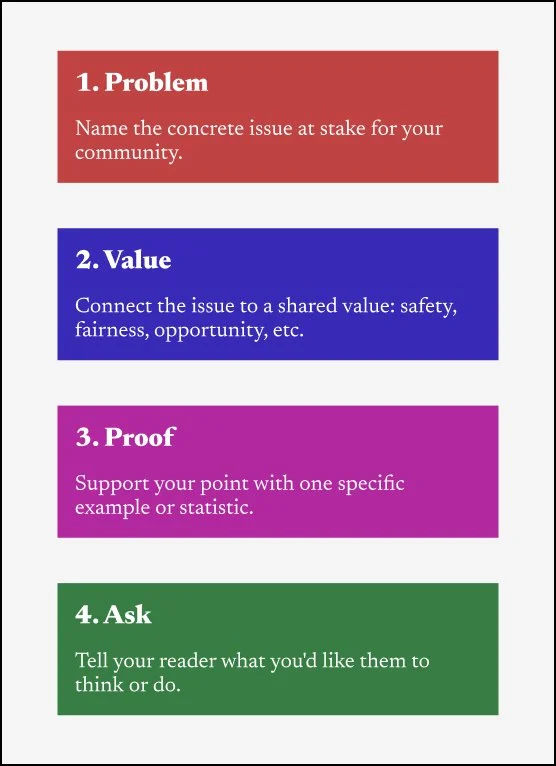
Outline your idea with this 4-stage messaging framework
1. Subject
Name the concrete issues that you’re writing about.
2. Value
Connect the subject to a shared value — safety, fairness, opportunity.
3. Proof
Support your point with one specific example or statistic.
4. Ask
Tell your reader what you'd like them to think or do.
If you can work through all four stages, you have the backbone of a strong letter.
Keep it short
Publications generally have a fairly tight word limit for letters. As a general rule, aim for 200 words or less, but check the guidelines for the specific publication before submitting. This is enough to make your point clearly without overstaying your welcome.
Start with a strong opening line
Editors read a lot of letters. A strong opening line makes yours stand out. Lead with your most compelling point rather than building up to it — you want to hook the reader in the first sentence, not the third.
Support your position with evidence
You're writing an opinion, but opinions are most persuasive when they're grounded in facts. If you can quote someone involved in the story, cite a statistic, or point to an article or announcement, it makes your position more grounded and convincing. Editors notice, and so do readers.
Mind your tone
A letter that is civil and respectful is far more likely to be published and to persuade others than an angry rant. That doesn't mean you can't be passionate; simply respect others. A few things to keep in mind:
Challenge ideas, not individuals.
Make your argument without attacking the people you disagree with.Avoid absolutes like "everyone knows" or "nobody believes."
They're easy to dismiss and undercut an otherwise strong argument.It's okay to strongly express opinions you hold passionately.
Just do it with respect, and with grounding in facts. A measured, thoughtful letter from someone who clearly knows their subject is far more convincing than a purely emotional one.
Close with your ask
End your letter by telling the reader what you'd like them to do or think. Sign a petition. Attend a meeting. Simply reconsider their position. A letter without a clear ask is a missed opportunity.
An example to illustrate these principles
Check out the text below for an example of an effectively structured letter to the editor.
A Letter to the Editor of The Emerald City Gazette
To the Editor:
Oz is no longer safe — and that goes for the good and the wicked alike.
Our community was founded on the belief that all residents deserve to live without fear, whether they are humans, munchkins, scarecrows, or witches. That shared value is under threat, and we can no longer afford to look the other way.
Consider what has happened in just the past week alone. A house fell from the sky and landed on a witch. Another witch was melted under circumstances that remain unclear. A scarecrow was nearly killed by flames. A tin man was found rusted to the point of immobility, unable to call for help.
These are not isolated incidents. These are signs of a community that needs to look out for one another.
I am calling on all residents of Oz to attend a neighborhood watch meeting this Thursday at 4 p.m. at the Emerald City Community Center. Combining our brains, heart, and courage we can band together to make Oz safer for everyone.
Respectfully,
Ozma Simmons
Munchkinland
Step 3: Submit Your Letter
You've written your letter, and it’s now time to get it out into the world. A few things to keep in mind:
What gets published about you
Most publications will print your full name and your community — your city, town, or neighborhood. They may also include a job title if it's relevant to the subject of your letter.
Before you submit, it's worth thinking about how you want to be identified. If you're writing on behalf of your employer or organization, make that clear. If you're writing strictly as a private citizen, it's fine to say so.
Submit to at least three publications
Submitting your letter to multiple publications at the same time is common practicem; we recommend you to submit to at least three publications. This can amplify your reach. And, for timely issues there may not be time to wait to see if one publication accepts your letter before submitting to another.
Where to submit
-
Word limit: 200
Word limit: 200
Cambridge News / Deerfield Independent
Word limit: 400
Capitol Times / WI State Journal
Word limit: 250
Word limit: 400
Herald Independent-McFarland Thistle
Word limit: 400
Lodi Enterprise & Poynette Press
Word limit: 400
Word limit: 400
Word limit: 400
Word limit: 400
Word limit: 400
Word limit: 200
-
Word limit: 500
Word limit: 200
Word limit: TBD
Word limit: 200
Additional areas
-
Word limit: 250
-
Word limit: 350
Word limit: 300
-
Word limit: 250
Word limit: 250
Word limit: 250
-
Door County Pulse
Letters to the Editor should be addressed to letters@ppulse.com with “Letter to the Editor” in the subject line.
Word limit: 350
Word limit: 250
Word limit: 250
Word limit: 450
-
Word limit: 275
Word limit: 350
Word limit: 250
-
Word limit: 250
-
Word limit: 250
Word limit: 350
-
Word limit: 350
-
Word limit: 200
-
Word limit: 250
-
Word limit: 250
-
Word limit: 250
Word limit: 400
-
Word limit: 500
Word limit: 250
Word limit: 500
Superior Telegram
Word limit: 300
-
Word limit: 350
-
Word limit: 250
Wausau Pilot & Review
What to expect after you submit
Publications receive many letters and cannot acknowledge every submission. Don't be discouraged if you don't hear back right away. If your letter is selected, an editor may reach out to verify your identity or make minor edits before publication. However, we find that most often, you’ll have to check the publication yourself to see if you’ve been published!
What if my letter isn't published?
It happens to everyone, and it's no reason to stop writing. There is very limited space in publications, and your letter may have been “good enough,” but simply cut because there was no space in that edition.
Nevertheless, before your next letter, consider sharing a draft with a friend or partner, and have them review these guidelines before offering feedback. A fresh set of eyes can catch things you might have missed and help sharpen your argument. Then try again. The writers who get published most are simply the ones who keep writing.
Want to do more?
The Columbia County Democrats are building a team of volunteer letter writers — people who want to work together to make sure local voices are heard on the issues that matter most to our community.
If that sounds like you, we'd love to hear from you. We'll keep you informed on issues and topics where letters can make a difference, and support you with guidance along the way.