

Your Voice Counts: How to Write a Letter to Your Representatives
Our elected representatives work for us all.
At every level of government — local, state, and federal — the people who represent you are accountable to you and your neighbors. Letting them know where you stand is not just your right; it is one of the most direct and meaningful ways to participate in our representative democracy.
Representatives and their staffs track the volume and content of mail from constituents. A letter from a real person in their district carries genuine weight. It shapes how they understand the priorities of the people they serve and how they vote.
You don't need to be a policy expert or a seasoned activist. You just need something to say. This guide will walk you through the process from start to finish:
Deciding who to contact
Writing your letter
Getting it into the right hands
-
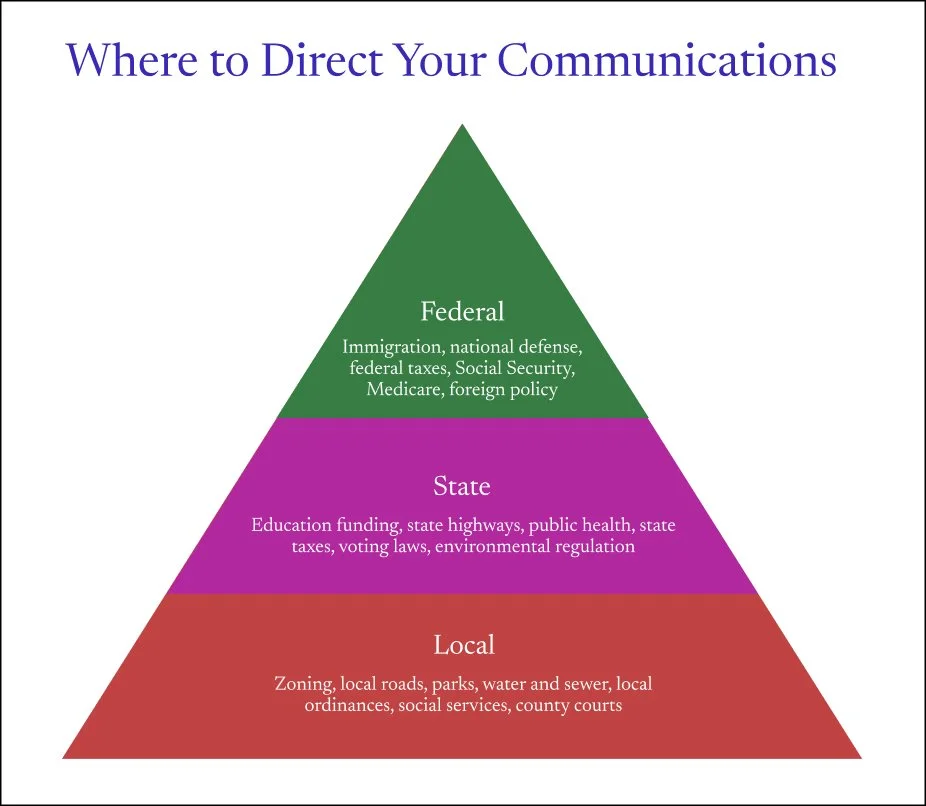
Local and county government handles the issues closest to home, the ones that affect your neighborhood, your roads, and your community services. If your concern involves zoning, local development, parks, water and sewer systems, or county social services, your local or county representatives are the right people to contact.
Finding your local & county representatives:
Columbia County Board of Supervisors
Not sure which district you live in?
Columbia County Supervisor District Maps
City, town, and village governments in Columbia County
Outside Columbia County?
Visit your county government's website to find your local representatives.
-
State government handles issues that affect all residents of Wisconsin, things like education funding, state highways, public health policy, state taxes, and voting laws. If your concern involves state legislation or policy, your state senator and state assembly representative are the right people to contact.
Finding your state representatives:
MyVote Wisconsin: search by address to find your elected state officials
Wisconsin Legislature District Map: find your specific state senator and assembly representative by address
-
Federal government handles national issues, things like immigration, national defense, federal taxes, Social Security, Medicare, and foreign policy. If your concern involves federal legislation or policy, your two U.S. senators and your U.S. representative are the right people to contact
Finding your federal representatives:
USAGov: find contact information for your senators, representatives, and other federal officials
Step 1: Decide Who to Contact
The first step in contacting your representatives is determining the right people to reach. Here we'll walk through the different levels of government and the kinds of issues each handles, so you can make sure you're contacting those who can best respond to your concerns.
Step 2: Write Your Letter
A letter to your representative doesn't need to be long or elaborate. It needs to be clear, specific, and focused. Here's how to put it together.
Structure your letter
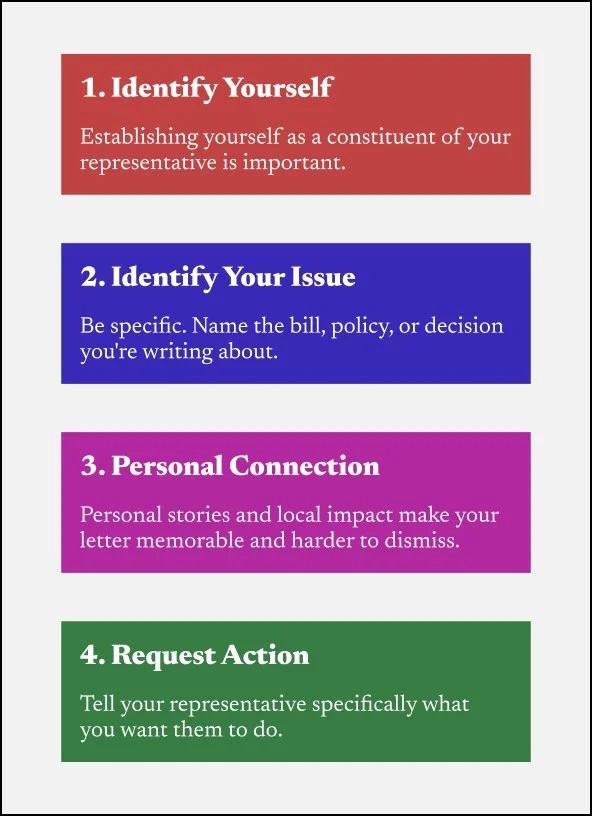
The most effective letters to representatives follow a simple, logical flow. Use this 4-stage framework to build yours:
1. Identify Yourself
State your name and where you live. Establishing yourself as a constituent is important — your representative is accountable to you in a way they are not accountable to anyone else.
2. Identify Your Issue
Be specific. Name the bill, policy, or decision you're writing about. A focused letter on a single issue is far more effective than a general expression of concern.
3. Connect to You or Your Community
Explain how this issue affects you, your family, or your neighbors. Personal stories and local impact make your letter memorable and harder to dismiss.
4. Request Action
Tell your representative specifically what you want them to do. Vote yes or no. Attend a meeting. Issue a statement. A letter without a clear, specific ask is a missed opportunity.
If you can work through all four stages, you have the backbone of a strong letter.
Start strong
Lead with who you are and why you're writing. Your representative's staff reads a lot of letters. A clear, direct opening makes yours easy to understand and hard to set aside.
Keep it focused
Each letter should address a single issue. If you have concerns about multiple issues, write separate letters. A focused letter is easier to act on and more likely to be taken seriously.
Keep it the right length
Aim for one easy-to-read page, or roughly 300 to 500 words. Long enough to make your case clearly, short enough to respect the time of your representative and their staff.
Close with your ask
Your closing should leave no doubt about what you want your representative to do. Be direct and specific. The more clearly you state your ask, the easier it is for your representative to act on it.
An example to illustrate these principles
Check out the text below for an example of an effectively structured letter to a representative.
A Letter to the Wizard of Oz
To the Wizard of Oz:
My name is Gimble, and I represent the Lollipop Guild and am a lifelong resident of Munchkinland. I am writing to urge you to cast a decisive yes vote on the Munchkinland Witch Harassment Prevention Act when it comes before you next week.
For the past three seasons, the Wicked Witch of the East has made it nearly impossible for my business to operate. Her hexes have spoiled our sugar supplies, frightened away our workers, and disrupted deliveries throughout the region. We have filed complaints, held community meetings, and appealed to local authorities, all without resolution.
The lollipop trade is the lifeblood of our community. My shop alone employs dozens of munchkins who depend on this work to support their families. If conditions do not improve, I will have no choice but to close my doors. The ripple effect on our local economy would be devastating.
The Munchkinland Witch Harassment Prevention Act offers a practical, long overdue solution to a problem that has gone unaddressed for far too long. I urge you to stand with the working munchkins of this community and vote yes.
Respectfully,
Gimble, Lollipop Guild, Munchkinland
Step 3: Get Your Letter Into the Right Hands
You've written your letter. Now let's make sure it reaches the people who need to see it.
Choose the Right Medium
Broadly, there are three main ways to contact your representative in writing. Each has its place.
-
Most representatives have an email address or an online contact form on their official website. This is the fastest and most direct way to get your message to the people who need to see it. Sending an email creates an electronic record of your communication, and if you're writing about a timely issue like an upcoming vote, it ensures that your message will reach their inbox in time.
-
A handwritten or printed letter sent by mail can feel more personal and deliberate than an email. For deeply personal issues, or ones that are less time-sensitive, a physical letter can carry additional weight. However, written letters take much longer to be received. First, it must make its way through the "snail mail" system. Then, it must be processed, which may entail added safety precautions that ensure the letter does not contain any harmful substances. It can often be weeks before a physical letter is fully processed.
-
Many representatives are active on social media and do monitor their accounts. However, the volume of noise in these channels means your message is far less likely to be seen or taken seriously than a direct email or letter. Posting on social media can still have value in helping your representative to see the tenor of the conversation around issues. But the specifics of your message are far more likely to be lost among the crowd than an email or a physical letter.
In most cases, email or online form submission is the most practical and effective choice because it is received instantly, it's easy for your representative's staffers to process, and the small additional effort to send the message directly (rather than via social media) elevates your voice above the fracas of online arguments.
Time Your Letter Well
Timing can make a real difference in how much impact your letter has.
If you're writing about an upcoming vote or decision, send your letter as early as possible. Representatives and their staffs need time to process constituent input before a vote takes place. A letter that arrives after a vote has been cast is too late to influence the outcome. Take this into consideration when choosing whether to send a physical letter or an email. Physical letters can take 3 to 4 weeks to be received and fully processed.
For issues that are not tied to a specific vote or deadline, letters are still valuable. Ongoing constituent interest in an issue signals to a representative that it matters to the people they serve, regardless of timing.
Find Your Representative's Contact Information
Contact information for your representatives can be found through the resources listed in Step 1 of this guide.
What to Expect After You Send
Most representatives should acknowledge their constituent's letters, although response times vary. A formal response may take days or even weeks, depending on the volume of mail the office receives. And, even though it is not a good practice, some representatives choose not to acknowledge the communications from their constituents (something you should keep in mind during their next election).
If your letter is about a time-sensitive issue, don't wait for a response before following up. A brief, polite follow-up email a few days before a vote is entirely appropriate.
Keep Writing
One letter is a good start. But the constituents who have the most influence are the ones who write regularly and persistently.
It's entirely appropriate to write to your representative multiple times about the same issue, but you should not simply be resending the same letter, or making the same case in every letter. Each letter should feel like the next chapter in the case you're making — a new development, a new piece of evidence, or a new angle on the same concern. Letters that build on one another signal sustained, serious concern.
Want to do more?
The Columbia County Democrats are building a team of volunteer letter writers — people who want to work together to make sure local voices are heard on the issues that matter most to our community.
If that sounds like you, we'd love to hear from you. We'll keep you informed on issues and topics where letters can make a difference, and support you with guidance along the way.