
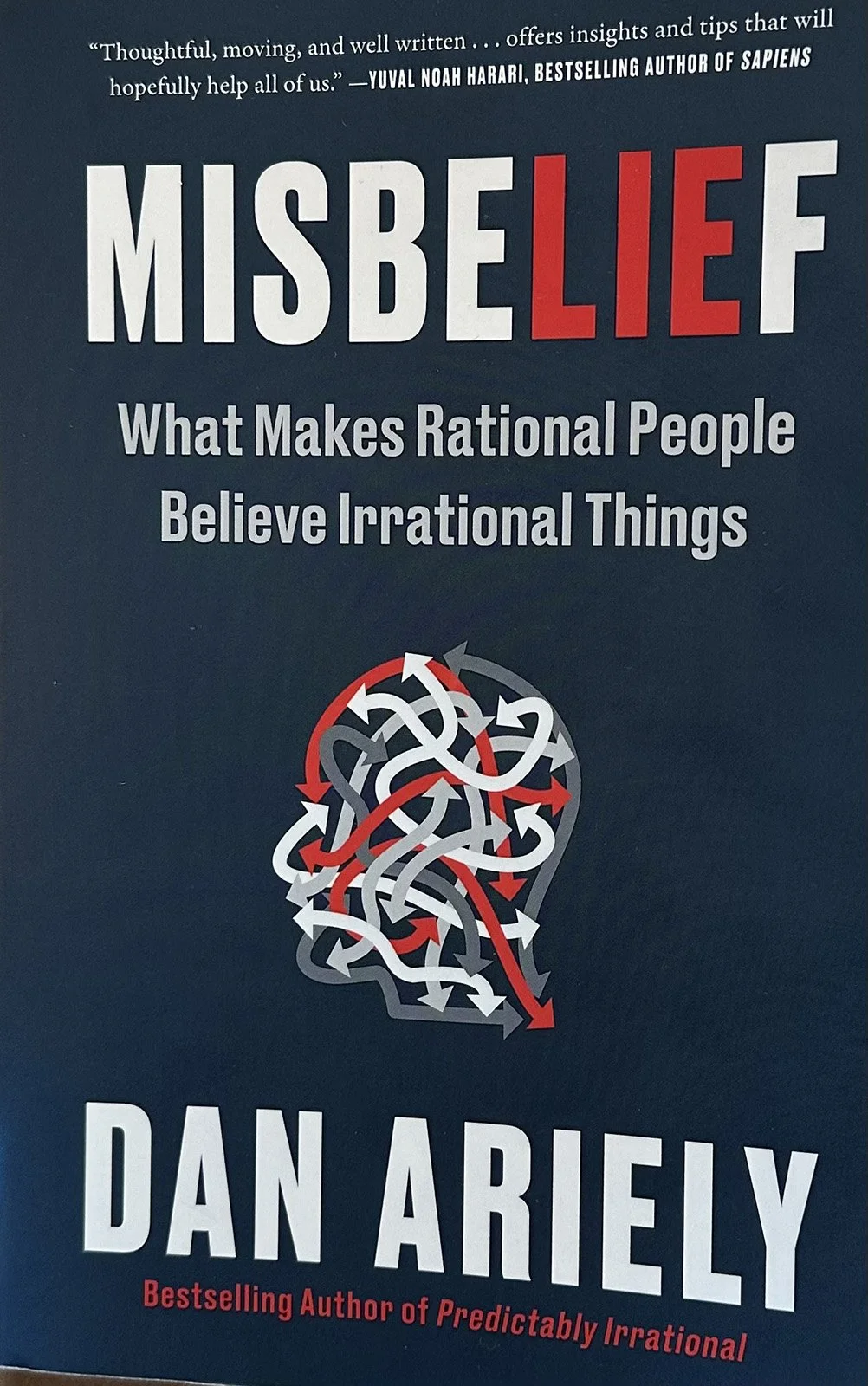
Book Review-Misbelief: What Makes Rational People Believe Irrational Things
A Review
by Mark Stover, CoCo Dems Second Vice Chair
Dan Ariely has been writing books about irrationality for awhile now. Predictably Irrational, The Upside of Irrationality, Irrationally Yours, and The Honest Truth About Dishonesty are some of his prior work.
During the Covid-19 pandemic, for a variety of reasons, Ariely became the target of what he calls "misbelievers" - people who mistakenly believed that Ariely was part of a plot to destroy freedom and cause harm to children by advocating for wearing masks in public during the time of the pandemic before we had a vaccine. Their misbelief ultimately led to calls for Ariely to be executed. What would drive formerly reasonable people to jump to such irrational conclusions and ultimately call for another human to be killed?
Ariely suggests that it was the result of a psychological funnel of misbelief to which people succumbed. The further they descended into the funnel the harder it was to escape. This is not a physical funnel - it is the culmination of a set of very human psychological processes that affect some people more than others.
Entering the funnel, according to Ariely, begins with emotional stress. Having your third grade kid kicked out of school during the pandemic for losing his mask is an example where one person began.
This rational person's cognitive abilities then kicked in to to try to understand what had happened and why. Particular personality traits like seeing patterns in data where there aren't any, false recall, overtrust in personal intuition, and decision-making biases then work together to give the misbelief emotional and intellectual life.
The final realm of the funnel is the power of social connection. Finding other people with the same misbelief (incredibly easy to do with social media and the internet) creates a sense of security. In fact, since many people who begin traveling through the funnel of misbelief are ostracized by their family and colleagues, finding a new set of friends who believe as strongly as you do is like a magnetic force.
Ariely concludes with five things he hopes reading the book will influence:
Identifying the psychology of misbelief and shining light on the danger it brings as well as the extent of the phenomenon.
Providing a guide to some of the traps in the funnel - and with increased awareness, increased ability not to succumb.
Create a sense of mission for people to help their friends and family to avoid the traps of the funnel with empathy.
Exposing the complexity of human nature and how it can be both at once wonderful and dangerous to ourselves and others.
Increasing our understanding of the value of trust and how much damage building mistrust can cause to our societies.
Finally, in the chapter on social structures, Ariely has a warning for those of us deeply engaged in political life. "When loyalty to a particular political persuasion becomes the overriding motive, facts become currencies of identity rather than objective truths."
This is a great book for understanding the most troubling parts of our societal fracture, how they came to be, and what steps each of us can take to heal the moment.